
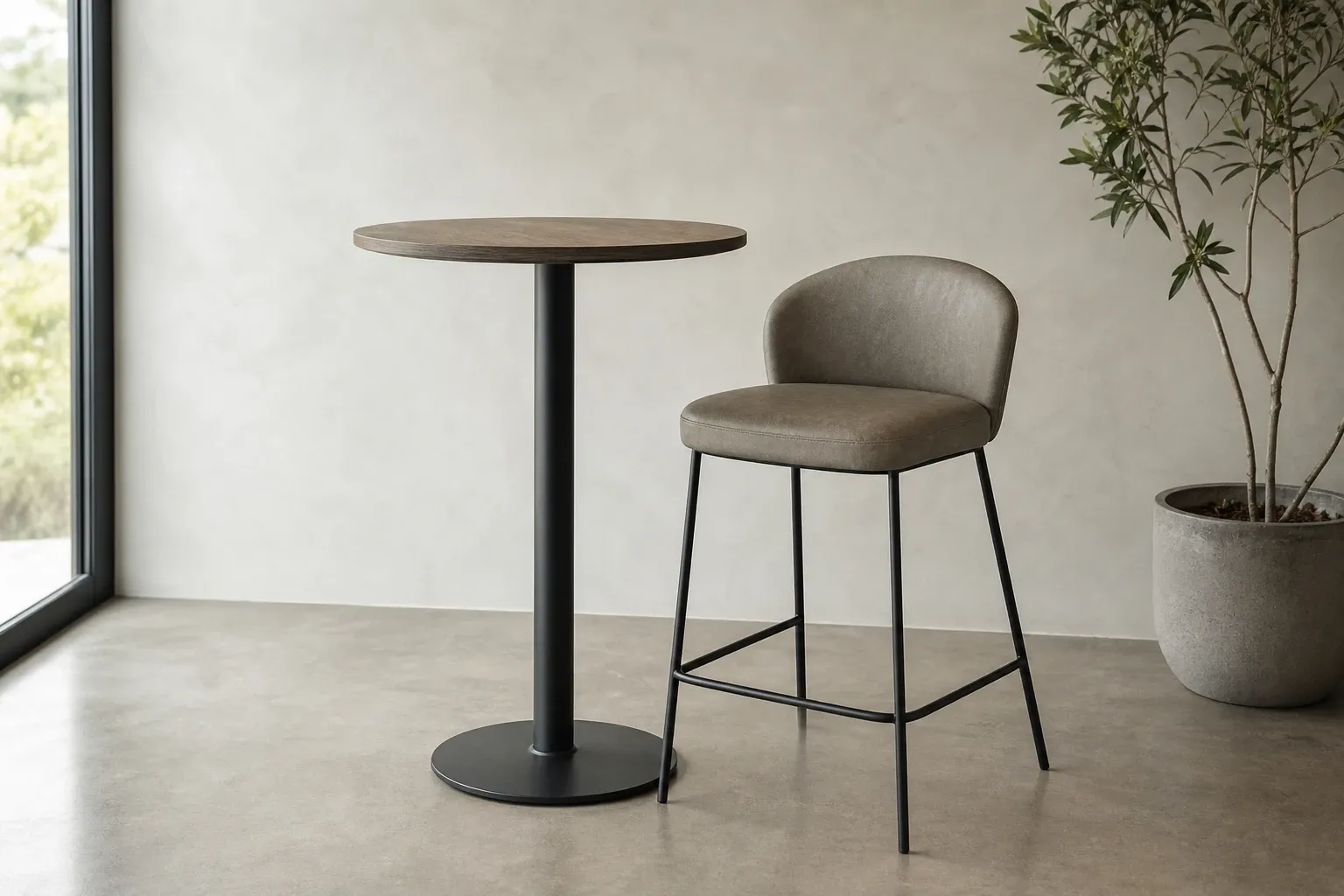
To match bar stool table height comfortably, measure from the floor to the poseur tabletop and to the stool seat. Then check the space beneath the table for knees and thighs. Subtract the seat height from the tabletop height to find the seating gap. Check the table’s underside too: a thick top or deep frame can reduce legroom.
This guide covers what to measure, how to compare the figures and what to check when pairing a stacking bar stool with a poseur table. There’s no need to assume either piece has standard dimensions; use the measurements of the furniture you’re considering.
Measure the poseur table height and stool seat
Start with the poseur table height: measure vertically from the floor to the top surface of the tabletop. Then measure the bar stool seat height from the floor to the surface where someone actually sits, rather than to the top of a backrest. Take both measurements with the furniture on a level floor so you are comparing like with like.
Next, measure from the floor to the lowest point beneath the table edge. An apron, support frame or thick tabletop can reduce the space available for knees and thighs, even when the tabletop height looks suitable. This underside measurement is especially useful if guests will sit close to the table rather than perch beside it.
Use the dimensions for the specific table and stool you plan to pair. Tabletop construction and stool designs vary. A label such as ‘poseur table’ or ‘bar stool’ cannot tell you whether the combination will fit. Keep all three figures together—tabletop height, clearance underneath and seat height—ready for the next step.
Calculate a comfortable bar stool table height pairing
Subtract the bar stool seat height from the poseur table height to find the gap between the seat and tabletop. This figure alone does not tell you whether there is enough legroom.
Next, subtract the seat height from the height to the table’s underside. This gives you a clearer measure of the space available above the seat for thighs and knees.
A thick tabletop or an apron beneath its edge can reduce clearance, even when the tabletop-to-seat calculation looks right. Measure to the lowest part where someone’s legs will sit, rather than relying on the height at the outer edge. Use these figures to narrow down a pairing. Then try the stool at the table where possible: the seat should be easy to reach, with room to sit without knees pressing against the underside.
Check legroom, foot support and space to sit down
Once seated, check where the stool’s footrest sits. If feet cannot rest comfortably on the floor, a usable footrest gives them somewhere to go; make sure it is easy to reach without stretching. Also check that the table base does not force the stool too far from the tabletop or get in the way of feet.
Allow space around the stool as well as beneath the table. Note its full footprint, including any legs that spread wider than the seat, and check that guests can pull it out, climb on and leave without blocking a walkway or neighbouring seat. In a busy venue, try the arrangement with adjacent stools in place rather than testing one in isolation.
Finally, ask someone to sit naturally and turn towards the table. If they have to perch on the seat edge or shift the stool sideways to avoid the base, the measurements may work on paper but the layout needs adjusting.
Pairing a stacking bar stool with a poseur table
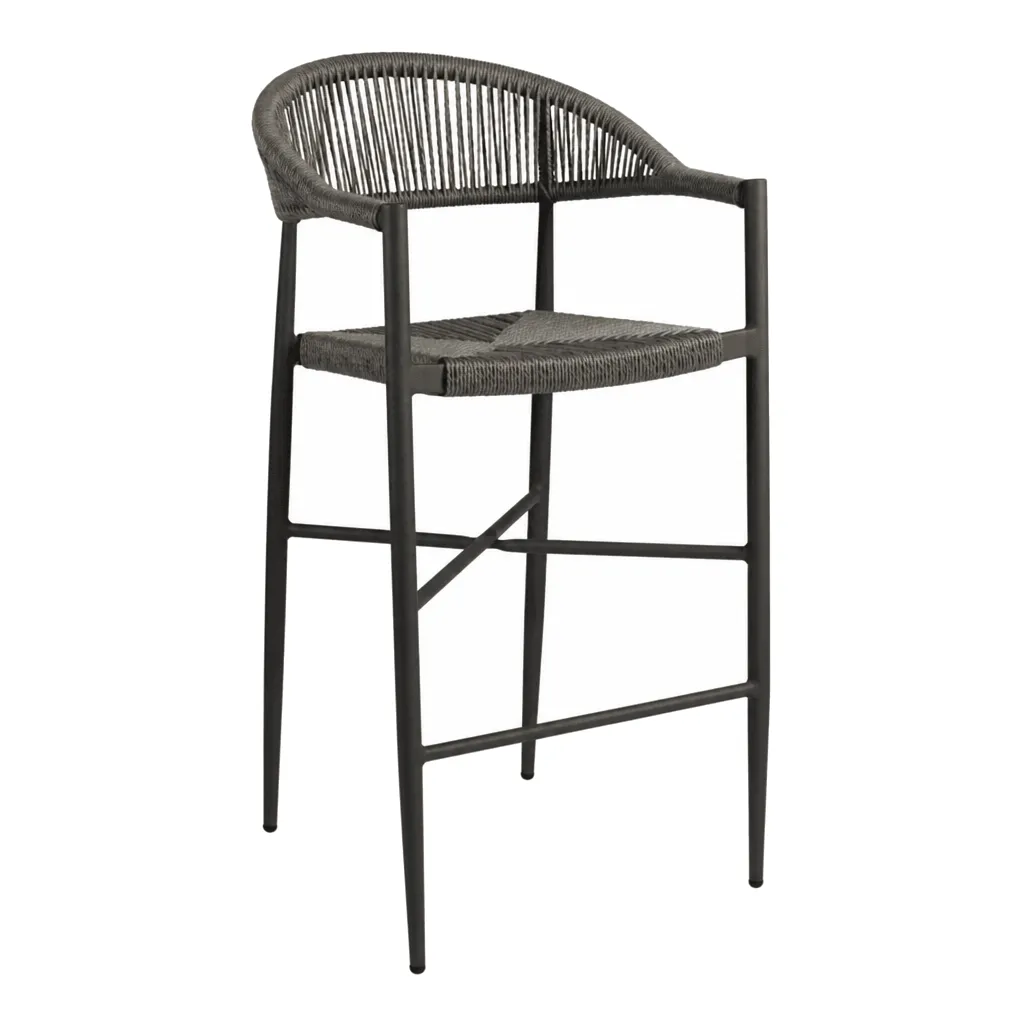
For a venue considering stackable seating, the Atlantic Stacking Bar Stool and Extrema Black Marble ‘Textured’ – Black Poseur Table are examples of products you might pair. Do not assume they fit together: check the actual stool seat height, tabletop height and clearance beneath the table before ordering.
The Atlantic stool is lightweight, stackable and weather-resistant, making it suitable for indoor and outdoor commercial use. The Extrema poseur table is described as resistant to weather, heat, stains and UV fading. Those features can be useful in a busy venue, but they do not tell you how much room a seated guest will have for their knees or feet.
Stackability helps when staff need to clear a floor area, change a seating layout or store spare stools between services. For more on choosing stools that suit those routines, read our guide to stackable bar stools for busy venues. If you are still deciding between seating types, see our guide to commercial bar chairs and bar stools.
Test the pairing for your venue
Once you have a likely match, try the stool and table together if you can. Sit as a guest would: check that your knees and thighs clear the underside, your feet have a comfortable place to rest, and you can get on and off without awkwardly shifting the stool. Notice whether you have to lean forwards or reach up to use the tabletop.
Check the bases as well as the heights. A stool may tuck neatly beneath one side but catch on the table base when several people sit around it, so try the number of stools you plan to use.
For an outdoor layout, test the pairing on the surface where it will stand, rather than assuming it will feel the same on a showroom floor. Leave enough room behind occupied stools for people to walk past without asking seated guests to move.
Measurements to confirm before ordering
Before ordering, record the tabletop height, the height to the underside of the top or frame, and the stool seat height. Check the usable space for knees and thighs, along with the footprint of both bases. Look for supports beneath the tabletop that could reduce legroom. Make sure the bases leave room to pull the stool out and sit down.
Compare the actual product dimensions rather than relying on labels such as ‘bar height’ or ‘poseur height’. Those names do not tell you how much clearance a particular pairing offers. If a specification is missing or the clearance looks tight, confirm the measurements with the supplier. Where possible, test one stool and table together before ordering the full quantity.
Frequently asked questions
Can a 65 cm seat-height stool work with a poseur table?
Yes, if the table height leaves a comfortable gap between the seat and the underside of the tabletop. Measure both heights rather than relying on the term ‘poseur table’, then check that someone seated has enough room for their knees and thighs.
Does the thickness of a poseur tabletop affect stool choice?
Yes. A thicker top reduces the space available beneath the table, even when its overall height stays the same. Measure to the underside of the tabletop, including any edge or support that could restrict legroom.
Does a bar stool need a footrest at a poseur table?
A footrest is worth considering when a stool is high enough that seated customers cannot rest their feet comfortably on the floor. Check where it sits in relation to the seat and table base, so customers can use it without their feet getting in the way.
How many bar stools can fit around one poseur table?
That depends on the tabletop size and shape, the width of the stools and the space needed to sit down and move around them. Mark out the stool positions before ordering, allowing room for elbows, table legs and circulation around the table.